Faces That Speak: The Power of Abhinaya in Kathak
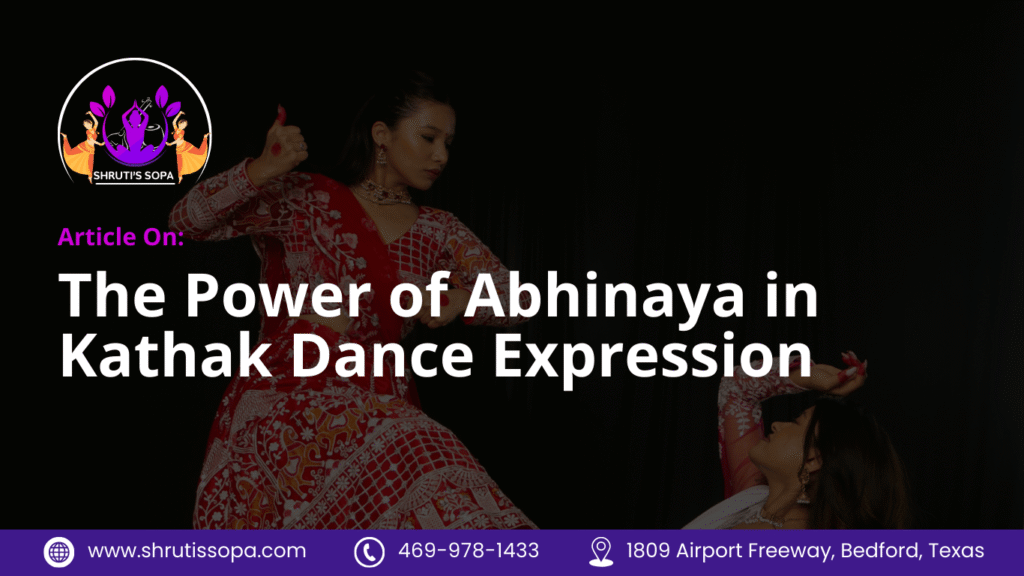
Kathak has visible virtuosity rapid footwork, complex rhythmic patterns, and dizzying spins. Yet to reduce Kathak to rhythm – which is often dictated by tatkaar, an expression through a dancer’s feet- alone is to miss its emotional core. That core is Abhinaya: the art of expression that allows Kathak to move beyond technique and become narrative. Through Abhinaya, the dancer’s face becomes a speaking surface, capable of conveying story, emotion, and psychological depth without a single spoken word.
The concept of Abhinaya originates in the ancient Indian treatise on performance, the Natyashastra, traditionally attributed to Bharata Muni. The text defines Abhinaya as the means by which meaning is carried toward the audience abhi (towards) and naya (to lead)
While all Indian classical dance forms employ Abhinaya, Kathak’s expressive style is distinct. Its emphasis on restraint, suggestion, and emotional subtlety reflects both its origins in oral storytelling and its later evolution in North Indian royal courts.
Kathak’s Storytelling Roots
Kathak traces its lineage to the kathakars, itinerant storytellers who narrated episodes from the Mahabharata and Ramayana using gesture, facial expression, and rhythmic footwork. Over time, this narrative tradition absorbed Persian aesthetics during the Mughal period, introducing refinement, lyricism, and an inward emotional gaze.
This dual inheritance devotional storytelling and courtly sophistication shaped Kathak Abhinaya into a form that favors implication over explanation. Emotion is not acted out; it is suggested, allowing the audience to complete the experience internally.

The Face as the Primary Site of Expression
In Kathak, the face particularly the eyes functions as the principal expressive instrument. Unlike dance forms that rely heavily on codified hand gestures (mudras), Kathak places extraordinary importance on drishti (eye movement), eyebrow articulation, and micro-expressions of the face. It is akin to Anne Sexton’s expression in her letters that “eyes are full of language”, and in this particular instant, the language of Kathak.
It is often said that Kathak Abhinaya often operates “through the smallest shifts of gaze and facial tension rather than overt gestural vocabulary”. A Kathak dancer may signal longing through a softened gaze, irony through a fleeting eyebrow lift, or devotion through stillness rather than motion. The face does not accompany the dance it leads it.
The Four Modes of Abhinaya in Kathak
The Natyashastra outlines four interdependent modes of Abhinaya, all of which are present in Kathak performance:
Angika Abhinaya refers to expression through the body and face. In Kathak, this is refined and economical. Facial expression often precedes physical movement, and stillness is treated as a legitimate expressive tool rather than an absence of action.
Vachika Abhinaya involves spoken or sung text. While Kathak dancers rarely speak on stage, their expressions are closely tied to poetic forms such as thumri, bhajan, and kavit. The dancer’s face responds directly to lyrical meaning.
Aharya Abhinaya encompasses costume, jewelry, and makeup. Kathak’s visual aesthetic is intentionally restrained light makeup, natural facial lines, and fluid costumes ensure that expression remains legible and unmasked. This restraint distinguishes Kathak from more heavily ornamented classical forms.
Sattvika Abhinaya is the most intangible and the most revered. It refers to involuntary, internalized emotional response tears that arise naturally, a tremor in the face, or a moment of suspended breath. Classical theory holds that Sattvika Abhinaya cannot be simulated; it emerges only when the dancer genuinely inhabits the emotional state being portrayed.

Comparison of the Four Types of Abhinaya in Kathak
| Type of Abhinaya | Core Meaning | How It Functions | Role in Kathak | Example in Performance |
| Angika Abhinaya | Expression through the body | Uses face, eyes, head, torso, and limbs to convey emotion and action | Highly refined and economical; facial expression often leads movement rather than follows it | A slight head tilt and softened gaze to suggest longing without overt gesture |
| Vachika Abhinaya | Expression through speech or sound | Relies on spoken word, sung poetry, or musical text | Indirect; the dancer does not speak but responds expressively to lyrics such as thumri, bhajan, or kavit | Facial reaction to a sung line describing Radha’s anticipation of Krishna |
| Aharya Abhinaya | Expression through appearance | Costume, makeup, jewelry, and visual presentation | Minimal and supportive; designed to highlight facial expression rather than dominate it | Light eye makeup and costume color reinforcing mood without masking expressions |
| Sattvika Abhinaya | Expression through inner emotion | Involuntary physical responses arising from genuine feeling | Central to powerful Kathak Abhinaya; cannot be mechanically taught | Natural tears, trembling lips, or breath suspension during an intense emotional moment |
Abhinaya and Character Transformation
One of Kathak’s defining expressive strengths is its ability to portray multiple characters in rapid succession. Through Abhinaya alone, a single dancer may shift between Radha, Krishna, a confidante, or a narrator sometimes within seconds. No costume change signals the transition; it is accomplished entirely through facial expression and altered gaze.
This technique is most clearly visible in gat bhav, a narrative form unique to Kathak. In gat bhav, the dancer presents a complete episode often drawn from Krishna lore using only expression, minimal gesture, and rhythmic punctuation.
The audience is not instructed on what to feel. Instead, it is trusted to recognize emotional cues and assemble meaning independently.
Discipline Behind Expressive Freedom
Despite its apparent spontaneity, Kathak Abhinaya is the product of rigorous training. Dancers spend years developing facial muscle control, emotional recall, and the ability to align expression precisely with rhythm and melody. Teachers emphasize that Abhinaya is not mimicry but internalization the dancer must experience emotion before attempting to express it.
Pandit Birju Maharaj, one of Kathak’s most influential figures, frequently stressed that Abhinaya begins “where technique dissolves into feeling.”

Abhinaya in Contemporary Kathak
Modern Kathak continues to rely on Abhinaya even as choreography expands to include contemporary themes such as identity, displacement, and social conflict. While rhythmic structures may evolve, expressive clarity remains essential. Without Abhinaya, Kathak risks becoming purely kinetic impressive, but emotionally distant.
Contemporary practitioners increasingly emphasize Abhinaya as the element that allows Kathak to communicate across cultures and languages, reinforcing its relevance in global performance spaces.
Conclusion
Abhinaya is not an ornamental layer in Kathak; it is the form’s emotional engine. Through restraint, precision, and inward focus, Kathak Abhinaya allows the face to become narrative, the eyes to become voice, and stillness to become meaning. When a Kathak dancer allows the face to speak, the audience does not merely watch the dance it listens.

Sruti Kafle
Sruti, the creative head and life behind Shruti’s School of Performing Arts (SOPA), is an accomplished Kathak performer and teacher. A graduate in Kathak from Allahabad University (Kathak Visharad), she has trained extensively through workshops in the Jaipur Gharana while specializing in the Lucknow style.
Wow😍😍. very detailed. Thank you for this beautiful explanation.